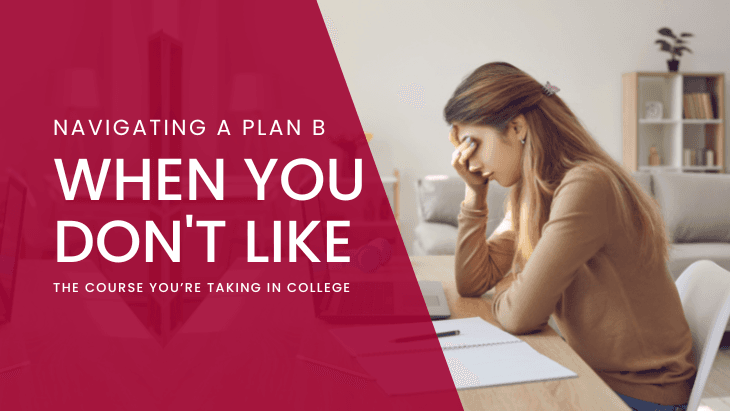
Navigating a Plan B When You Don’t Like the Course You’re Taking in College
Choosing a college course is often presented as a life-defining decision, but in reality, many students discover along the way that what they selected no longer excites them. Sometimes expectations do not match reality. Sometimes interests evolve. Other times external pressure influences decisions more than personal curiosity. Realising that you don’t enjoy your course can feel stressful, but it does not mean you are stuck or falling behind. A Plan B is not giving up — it is creating possibilities.
UNDERSTANDING THAT IT IS NORMAL TO CHANGE DIRECTION
College is often the first environment where students begin understanding themselves more deeply. It is natural for interests, goals, and motivations to change during this period. Discovering that your course no longer aligns with your interests does not mean the time spent was wasted. Every experience develops transferable skills, discipline, and perspective that remain valuable regardless of career direction.
STEP BACK AND RE-EVALUATE WHAT YOU WANT
Before making any major decision, take time to understand what exactly feels wrong. Is it the subject itself? The teaching style? The pressure? Or the career path connected to it?
Write down what energises you and what consistently drains you. Think about the activities, projects, or topics you naturally enjoy outside academics. Clarity often comes from reflection rather than immediate action.
EXPLORE ALTERNATIVE CAREER PATHS
Not liking your course does not mean you need to abandon your future plans entirely.
Many careers today are built through combinations of skills rather than a single degree. Explore adjacent fields, interdisciplinary opportunities, certifications, internships, and industries that connect with your strengths and interests.
Sometimes a small shift creates more fulfilment than a complete restart.
LEARN SKILLS OUTSIDE THE CLASSROOM
Your degree is only one part of your professional identity.
Online learning, projects, communities, workshops, certifications, and self-learning can help you discover entirely new interests. Whether it is design, technology, marketing, writing, business, analytics, or entrepreneurship, additional skills can open doors beyond your formal curriculum.
Learning independently also helps build confidence in your ability to adapt.
TALK TO PEOPLE WHO HAVE TAKEN DIFFERENT PATHS
Conversations can reveal possibilities you may not have considered.
Speak to seniors, professionals, alumni, mentors, or people working in industries that interest you. Ask how they entered their field, what skills mattered most, and whether their degree directly matched their current role.
You’ll often discover that careers are rarely linear.
BUILD EXPERIENCE BEFORE MAKING BIG DECISIONS
Before switching completely, test your interests.
Take short courses.
Work on small projects.
Volunteer.
Freelance.
Apply for internships.
Shadow professionals.
Real experience provides stronger answers than assumptions.
DON’T TREAT PLAN B AS FAILURE
Many people hesitate to explore alternatives because they think changing direction means losing.
It doesn’t.
Plan B is not a backup for unsuccessful people.
It is a strategy created by people who are willing to adapt and grow.
The goal is not to defend past decisions forever — it is to create a future that feels meaningful.
MAKE A PRACTICAL TRANSITION PLAN
Big changes become easier when broken into smaller actions.
Identify the skills you need.
Create a timeline.
Build a portfolio.
Set learning milestones.
Track progress.
You do not need every answer immediately.
You only need enough clarity for the next step.
CONCLUSION
Not liking your college course does not mean you have failed.
It means you are becoming more aware of who you are and what you want.
Degrees matter, but curiosity, adaptability, and willingness to learn often matter more.
Your current path does not have to become your permanent destination.
Sometimes discovering what doesn’t fit is the first step toward discovering what does.